Choosing the best dissolvable 3D printer filament enhances your printing experience by allowing easy removal of supports and creating intricate designs. Dissolvable filaments typically dissolve in water or specific solvents, preserving delicate parts and reducing manual cleanup. Below is a summary table of top-rated dissolvable filaments that excel in performance, compatibility, and ease of use.
| Product | Brand | Material Type | Dissolves In | Spool Weight |
|---|---|---|---|---|
| Fused Materials PVA 3D Printer Filament | FUSED MATERIALS | PVA (Polyvinyl Alcohol) | Water | 1 kg |
| Polymaker PolyDissolve S1 PVA Filament | POLYMAKER | PVA | Water | 750 g |
| YXPOLYER HIPS Filament | yxpolyer | HIPS (High Impact Polystyrene) | Limonene | 1 kg |
| RepRapper PVA Filament | RepRapper | PVA | Softens in Warm Water | 0.5 kg |
| CARBON Certified Food Grade PLA+ | CARBON | PLA+ | Not Dissolvable | 1 kg |
Fused Materials PVA Dissolvable Filament for 3D Printers

Fused Materials PVA offers a professional-grade, water-soluble filament designed primarily for dual extruder 3D printers. It excels as a support material for complex shapes and castings with a smooth, bubble-free extrusion and high toughness.
- Premium PVA ensuring better dissolvability and no warping.
- Certified safe with ROHS and CE standards.
- Optimized for PLA compatibility for user-friendly printing experiences.
Polymaker PolyDissolve S1 Water Soluble Filament

This water-soluble PVA filament by Polymaker is tailored for use with PLA, TPU, PVB, and Nylon. It’s ideal for printing complex internal cavities and detailed architectural designs.
- Comes tangle-free and moisture-free, vacuum-sealed with a desiccant for optimal storage.
- Uses sustainable, recycled cardboard spool packaging.
- Supports detailed prints that require reliable support dissolution.
YXPOLYER HIPS Soluble Support Filament for ABS

YXPOLYER HIPS filament is an excellent alternative for users printing with ABS. This high-impact polystyrene dissolves in limonene, providing reliable support removal without harming intricate model details.
- Exceptional toughness and resilience for prototypes to functional parts.
- Designed specifically as a support material compatible with ABS.
- Easy dissolution with limonene solvent, making post-processing gentler.
RepRapper 3D Printer PVA Filament for Supports

This PVA filament from RepRapper is designed to soften in warm water rather than fully dissolve, offering manual removal support without damaging print surfaces. It works well for large-area supports but can be challenging in confined spaces.
- Good thermal stability with printing temperatures between 190-210°C.
- Compatible with nearly all FDM 3D printers.
- Print settings optimized for flexible needs, including drying recommendations before printing.
CARBON Certified Food Grade PLA+ Filament
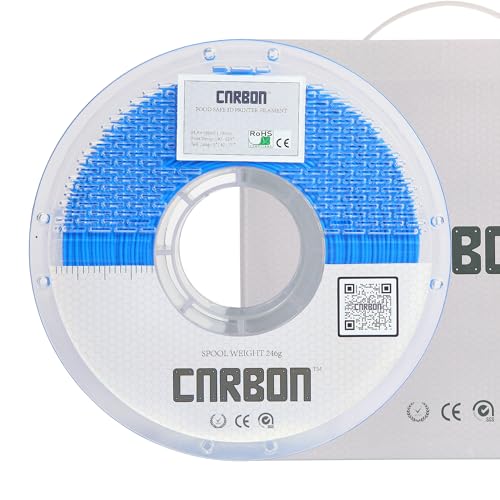
Although not dissolvable, the CARBON PLA+ filament stands out for its food-grade certification and lab testing for safety in contact with food. It is extruded from renewable plant-based resin with precise dimensional accuracy for smooth printing.
- Certified food-grade by TÜV SÜD and SGS, complying with FDA regulations.
- Low carbon footprint, eco-friendly, and renewable.
- High accuracy diameter (+/- 0.02 mm) for consistent results.
Buying Guide for Dissolvable 3D Printer Filament
When selecting dissolvable 3D printer filament, consider the following key factors to ensure optimal performance for your printing projects:
1. Compatibility with Your Printer and Filaments
Most dissolvable filaments are designed for dual extruder 3D printers to print support material separately from the primary object filament. Confirm your printer supports the filament diameter (usually 1.75mm) and temperature settings. PVA filaments pair well with PLA, TPU, and nylon, while HIPS works best with ABS.
2. Dissolution Medium and Speed
PVA filaments typically dissolve in water, with some taking a few hours at room temperature or faster in warm water. HIPS filaments dissolve in limonene, a solvent that requires careful handling but may speed up removal. Choose a filament with a dissolution method that suits your workspace and post-processing capabilities.
3. Storage and Moisture Sensitivity
PVA is hygroscopic and tends to absorb moisture from the air, which can affect print quality. Look for filaments that come vacuum-sealed with desiccants and store them in sealed containers to maintain filament integrity.
4. Print Quality and Dimensional Consistency
Filaments with tight diameter tolerances (+/- 0.02 mm) promote smooth feeding and precise prints. Quality control affects bubbling, warping, and layer adhesion, so opt for reputable brands with consistent manufacturing standards.
5. Environmental and Safety Considerations
Some dissolvable filaments are biodegradable and certified safe for eco-conscious users. Also, consider solvents used for dissolving supports like limonene, which require ventilation and proper handling. Food-grade certifications may be essential if printing parts in contact with food.
6. Support Removal Complexity
Evaluate whether you prefer complete dissolution in water or partial softening for manual removal. Full dissolution eliminates manual cleanup but takes longer, while softening allows faster removal but can be tricky in tight spaces.
7. Packaging and Spool Size
Larger spools reduce spool changes during long prints, saving time and reducing filament waste. Some brands provide eco-friendly or recycled packaging that appeals to environmentally conscious users.
By considering these aspects, you can select the best dissolvable filament tailored to your printing needs, ensuring high-quality prints with minimal post-processing effort.