Best Flexible 3D Printer Filaments for Durable and Precise Printing
Choosing the best flexible 3D printer filament is essential for projects that require elasticity, durability, and excellent print quality. Flexible filaments like TPU (Thermoplastic Polyurethane) offer resilience for wear-resistant parts, protective cases, and more. Below is a summary table highlighting top flexible filaments known for their Shore 95A hardness, high elasticity, and printing consistency.
| Product | Brand | Shore Hardness | Weight | Key Feature |
|---|---|---|---|---|
| SUNLU TPU 3D Printer Filament | SUNLU | 95A | 1 KG | High-speed TPU filament for fast printing with smooth finish |
| OVERTURE TPU Filament | OVERTURE | 95A | 1 KG | Clog-free formula with pre-dried and vacuum-sealed packaging |
| Geeetech TPU Filament | Geeetech | 95A | 1 KG | High elasticity with strong layer adhesion and anti-aging properties |
| Comgrow TPU Filament | Comgrow | 95A | 1 KG | Soft filament with precise dimensional accuracy |
| Creality TPU Filament | Creality | 95A | 1 KG | Exceptional wear and chemical resistance with easy printing experience |
SUNLU TPU 3D Printer Filament – High Speed and Flexible

SUNLU’s TPU filament is engineered for fast printing speeds, boasting up to three times the speed of conventional TPU filaments. With a Shore hardness of 95A, it balances flexibility and toughness, making it suitable for applications like robotics and fashion accessories. The filament features excellent layer adhesion, resulting in prints with smooth finishes and structural integrity. This TPU withstands collisions and daily wear, ideal for functional and decorative prints.
OVERTURE TPU Filament – Durable and Clog-Free Printing

The OVERTURE TPU filament offers unmatched flexibility and resilience with a Shore hardness of 95A. It ensures a clog-free and bubble-free printing experience thanks to its patented formula and thorough 24-hour drying process before vacuum sealing. The spool is designed to maintain performance when stored properly. The filament delivers superior layer bonding and smooth surfaces, perfect for flexible parts requiring durability and aesthetic quality.
Geeetech TPU Filament – High Elasticity and Wear Resistance
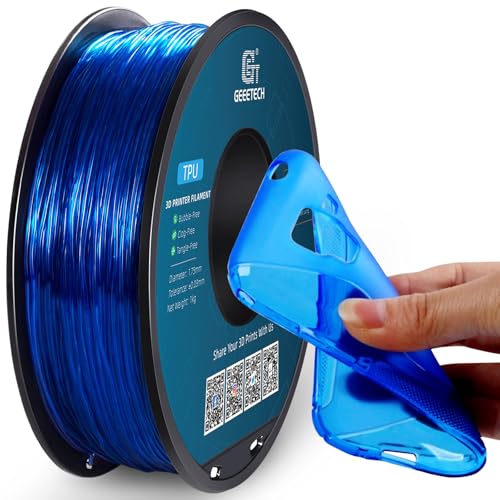
Geeetech TPU stands out for its exceptional elasticity and toughness, suitable for applications like phone cases, watch bands, and robotics. With precise dimensional accuracy (±0.03mm) and a 95A Shore hardness, it resists wear, impacts, and stretching. Advanced clog-free technology and pre-drying reduce printing issues. Strong layer adhesion avoids delamination, ensuring smooth, durable prints resistant to aging and cracking over time.
Comgrow TPU Filament – Precise and Flexible TPU Material

The Comgrow TPU filament offers a soft and flexible 95A Shore hardness material with excellent bendability and structural integrity. This filament has a dimensional accuracy of ±0.02 mm, ensuring consistent print diameter for precise and reliable printing on most FDM 3D printers. Its flexibility makes it ideal for printing parts that require stretch and resilience without sacrificing durability.
Creality TPU Filament – Durable with Chemical Resistance

Designed for impact and chemical resistance, the Creality TPU filament features a Shore hardness of 95A and delivers parts that withstand wear, tear, and harsh environments. Its excellent tear resistance suits protective cases and automotive parts. This filament provides easy printing with high resilience and reduced odor, suitable for a variety of flexible functional prints that require durability and chemical stability.
Buying Guide for Flexible 3D Printer Filaments
When selecting the best flexible 3D printer filament for your needs, consider the following important factors:
- Material Type: TPU is the most common flexible filament, known for its elasticity and strength. Some projects may require other flexible materials, but TPU’s balance of flexibility and toughness is ideal for most applications.
- Shore Hardness: Filaments with a Shore hardness around 95A offer the best compromise between softness and durability, perfect for parts that must flex without breaking.
- Dimensional Accuracy: Precise filament diameter (±0.02 to ±0.05 mm) ensures consistent extrusion and good print quality. High accuracy reduces print failures and improves layer adhesion.
- Printing Speed: Some filaments, like SUNLU High Speed TPU, allow faster printing without sacrificing quality, saving time on complex projects.
- Compatibility: Most flexible filaments work with FDM printers, but ensure your printer supports TPU and flexible materials. Direct drive extruders generally provide better results than Bowden setups.
- Print Surface Adhesion and Warping: Good filaments offer excellent bed adhesion and low warp tendency, critical for clean prints without deformation.
- Packaging: Vacuum-sealed spools with desiccants reduce filament moisture absorption, which can cause bubbling and clogging during printing.
- Layer Adhesion and Surface Finish: Strong interlayer bonding prevents delamination in flexible prints and delivers smooth, professional-quality surfaces.
- Durability: Consider wear resistance, tear resistance, and chemical resistance depending on usage—important for parts exposed to mechanical stress or harsh environments.
Assessing these elements for your print projects will help you choose the filament that best meets your needs for flexibility, reliability, and print quality.