Selecting the right filament for high temperature 3D printing ensures your projects can withstand heat, stress, and outdoor conditions. This guide covers top-performing filaments designed for durability, heat resistance, and exceptional print quality, suitable for various demanding applications. Below is a summary table of featured high temperature 3D printer filaments to help you compare key features at a glance.
| Product | Brand | Heat Resistance | Key Feature |
|---|---|---|---|
| Creality ASA Filament 1.75mm, 1kg Spool | Creality | Up to 100°C | UV & Weatherproof for Outdoor Use |
| Official Creality Hyper ABS Filament 1.75mm, 1kg Spool | Creality | Up to 80°C | Fast Printing with High Strength |
| RANKI Polycarbonate Filament 1.75mm 1KG | RANKI | 100-120°C | Excellent Weather & UV Resistance |
| ELEGOO Carbon Fiber PAHT Filament 1.75mm 0.5KG | ELEGOO | Up to 194°C | Carbon Fiber Reinforced High Strength |
| 3D-Fuel High Temp Tough Pro PLA+ 1.75mm 1kg | 3D-FUEL | Heat Resistant with PLA Ease | Strong and Annealable for Extra Durability |
Creality ASA Filament 1.75mm for Outdoor Functional Parts

The Creality ASA Filament features impressive sunscreen and weatherproof properties, designed to protect your 3D printed models from UV radiation, aging, and corrosion. Its dimensional accuracy within +/- 0.03mm ensures precise prints, making it ideal for outdoor and functional parts exposed to sunlight for long durations. The filament maintains integrity even at 100°C, outperforming typical PETG and ABS materials in heat tolerance. Its tough and impact-resistant nature supports structural applications requiring long-lasting durability.
Official Creality Hyper ABS Filament 1.75mm High Temp Resistance

The Creality Hyper ABS Filament stands out with its safety and environmental credentials, utilizing low residual monomer materials that reduce harmful volatiles during printing. It supports print speeds up to 350mm/s and is compatible with most 3D printers using 1.75mm filament. This filament tolerates heat up to 80°C, which is significantly higher than standard PLA, making it suitable for parts exposed to mechanical stress and moderate heat conditions. Widely used in industry and automotive applications, it balances strength with fast printability.
RANKI Polycarbonate Filament 1.75mm for Outdoor Use
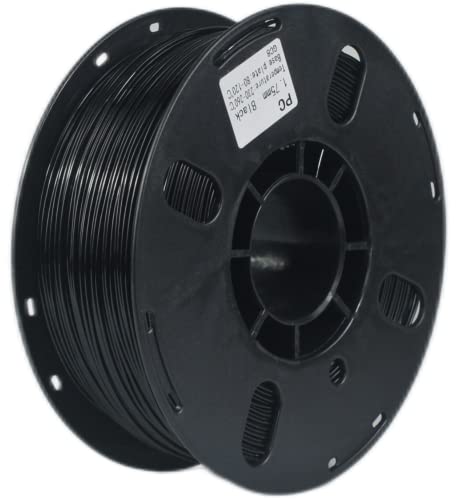
RANKI Polycarbonate Filament offers superior weather resistance and UV protection, thanks to its UV absorbers and protective co-extrusion layers. It is highly suited for outdoor applications due to its excellent toughness and yellowing prevention. Rated for continuous use in environments between 100°C and 120°C, this filament allows for printing parts requiring long-term heat endurance and rigidity. It features high purity and fluidity, providing smooth feeding without jamming during prints.
ELEGOO Carbon Fiber PAHT 1.75mm High Strength Filament

The ELEGOO Carbon Fiber PAHT Filament combines nylon with carbon fiber reinforcement, offering outstanding strength and rigidity. It withstands ambient temperatures up to 194°C, making it one of the highest temperature-resistant filaments available. Its low water absorption ensures consistent printing quality, while superior interlaminar adhesion results in robust, durable prints. This filament is ideal for technical parts in demanding automotive or industrial environments where both mechanical strength and heat resistance are critical.
3D-Fuel High Temp Tough Pro PLA+ Filament 1.75mm
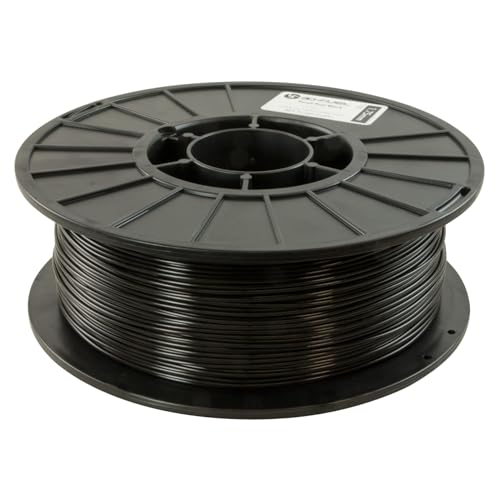
3D-Fuel’s Tough Pro PLA+ filament is engineered to balance ease of printing with enhanced durability and temperature resistance. It delivers strength approximately 8.8 times greater than regular PLA and can be annealed for even higher performance. This filament offers excellent dimensional accuracy with ±0.02mm tolerance and vacuum-sealed packaging to maintain filament dryness. It is universally compatible with most 1.75mm 3D printers, suitable for users needing strong, reliable prints with heat stability rivaling ABS.
Buying Guide for High Temperature 3D Printer Filaments
Choosing the appropriate high temperature 3D printing filament depends on several key factors. This guide highlights essential considerations to help you select the optimal filament for your projects and printing setup.
Heat Resistance Requirements
Determine the maximum temperature your printed parts will encounter. Filaments like ELEGOO PAHT-CF can withstand near 194°C, ideal for automotive or engineering parts, while Creality ASA and RANKI Polycarbonate suit outdoor use with heat tolerance around 100-120°C. Match filament specs with real-world thermal exposure for durability.
Mechanical Strength and Durability
For parts subjected to mechanical stress, consider reinforced filaments such as carbon fiber-infused or tough PLA+ variants, offering high tensile strength and stiffness. The ELEGOO Carbon Fiber PAHT and 3D-Fuel Tough Pro PLA+ provide excellent strength and impact resistance suitable for functional components.
Weather and UV Resistance
If printing items exposed to sunlight or harsh environments, select filaments with added UV protection and weatherproof properties, like Creality ASA or RANKI Polycarbonate. These filaments maintain color, shape, and integrity despite prolonged UV exposure and moisture.
Printing Compatibility and Ease
Check filament compatibility with your 3D printer’s extruder and bed setup. Some high-temp filaments require enclosed printers or specific temperature capabilities. Filaments like 3D-Fuel PLA+ and Creality Hyper ABS emphasize ease of use and wide printer compatibility while balancing heat resistance.
Print Speed and Quality
Consider filaments that achieve faster print speeds without sacrificing quality, especially for professional or industrial use. Creality’s Hyper ABS filament offers printing speeds up to 350mm/s, enhancing efficiency for large batch prints.
Dimensional Accuracy and Consistency
High dimensional accuracy ensures precision in functional prototypes and parts fitting. Look for filaments providing tight diameter tolerances (±0.02 to ±0.05 mm) to minimize nozzle jams and produce consistent layers.
By evaluating these factors—heat tolerance, strength, environmental resistance, printer compatibility, and print accuracy—you can confidently select a high temperature 3D printer filament tailored to your application needs.