You don’t need a production cutter to trim a few planner inserts or homemade cards, but you do need a tool that suits the way you work. For occasional home projects, the most useful differences are the cutting mechanism, how you align a page, and where the tool will live between jobs.
This research-based shortlist compares the Fiskars SureCut Deluxe 12-inch, Dahle 507, and Swingline ClassicCut Lite 9312. You’re getting documented features and practical buying tradeoffs, not claims from a hands-on cutting test.
Choose the mechanism before the maximum stack
If you mainly trim individual printed pages and want to see the intended line, start with the Fiskars sliding-blade design. If you prefer an enclosed rotary head and automatic clamping, look at the Dahle 507.
The Swingline is the lever-style option for light document batches, provided you’re comfortable with its cutting arm and storage latch. None of these choices turns a maximum sheet count into a promise of perfect alignment on your particular cardstock.
Your actual paper matters: a stack of ordinary office sheets isn’t equivalent to the same count of heavier card. Plan to begin with a small sample, and use the exact model’s instructions rather than extending a capacity claim to unfamiliar materials.

Fiskars SureCut Deluxe: for seeing where a single page will cut

You should consider the SureCut Deluxe if your work often starts with one printed sheet and a crop mark. Fiskars documents a wire cut-line, a blade carriage guided along a rail, and an extending measurement arm.
The wire gives you a visual reference for placing the page before cutting, while the swing-out arm supports measuring wider material. Those are useful design features when you’re comparing trim positions, not evidence that every cut will be accurate without careful setup.
Fiskars lists a 12-inch cutting length and compatibility with its style I TripleTrack blades. The inspected Amazon selection identifies model 152490, one trimmer, in the SureCut Deluxe New style; check that selection when you open the listing.
The manufacturer’s catalog page uses the fuller article number 152490-1008, so keep that distinction in mind when sourcing replacement parts. Don’t assume a blade for another Fiskars trimmer fits merely because the handle or packaging looks familiar.
You should skip this design if you expect to process large batches or want a heavier office fixture that stays permanently on a counter. Its appeal here is an occasional craft workflow with visible alignment, not a documented advantage in high-volume work.
Before buying, find the compatible replacement blade and consider where you’ll keep it securely. An inexpensive-looking trimmer becomes less convenient if you can’t identify its consumables when the cutting edge needs attention.
Dahle 507: for a guided rotary head and automatic clamp

You should consider the Dahle 507 when you like the idea of moving a rotary head along a guide bar rather than lowering a lever. Dahle documents a blade inside a protective housing, automatic paper clamping, and a metal base with alignment markings.
The North American product page specifies a 12-inch cutting length and seven-sheet capacity for item 00507-24040. The inspected Amazon listing names that same model number; it’s distinct from the longer 508 and from replacement-head listings.
The automatic clamp is the feature to consider if you find it awkward to hold and align a loose page while operating a cutter. You still need to place the sheet squarely and keep your hands in the positions the instructions permit.
Dahle describes its blade as self-sharpening and able to cut in both directions. That construction claim doesn’t remove the need to inspect cut quality, follow maintenance guidance, or resolve damage before continuing to use the tool.
You should skip the 507 if your project regularly needs a longer cut than its documented range or thick stacked materials. Looking at another model’s higher capacity won’t make those materials suitable for this exact one.
Keep the model code when shopping for accessories because different generations and nearby model names can appear together in search results. Match the accessory maker’s compatibility statement to the code on your tool before ordering.
Swingline ClassicCut Lite 9312: for a lever-style document workflow
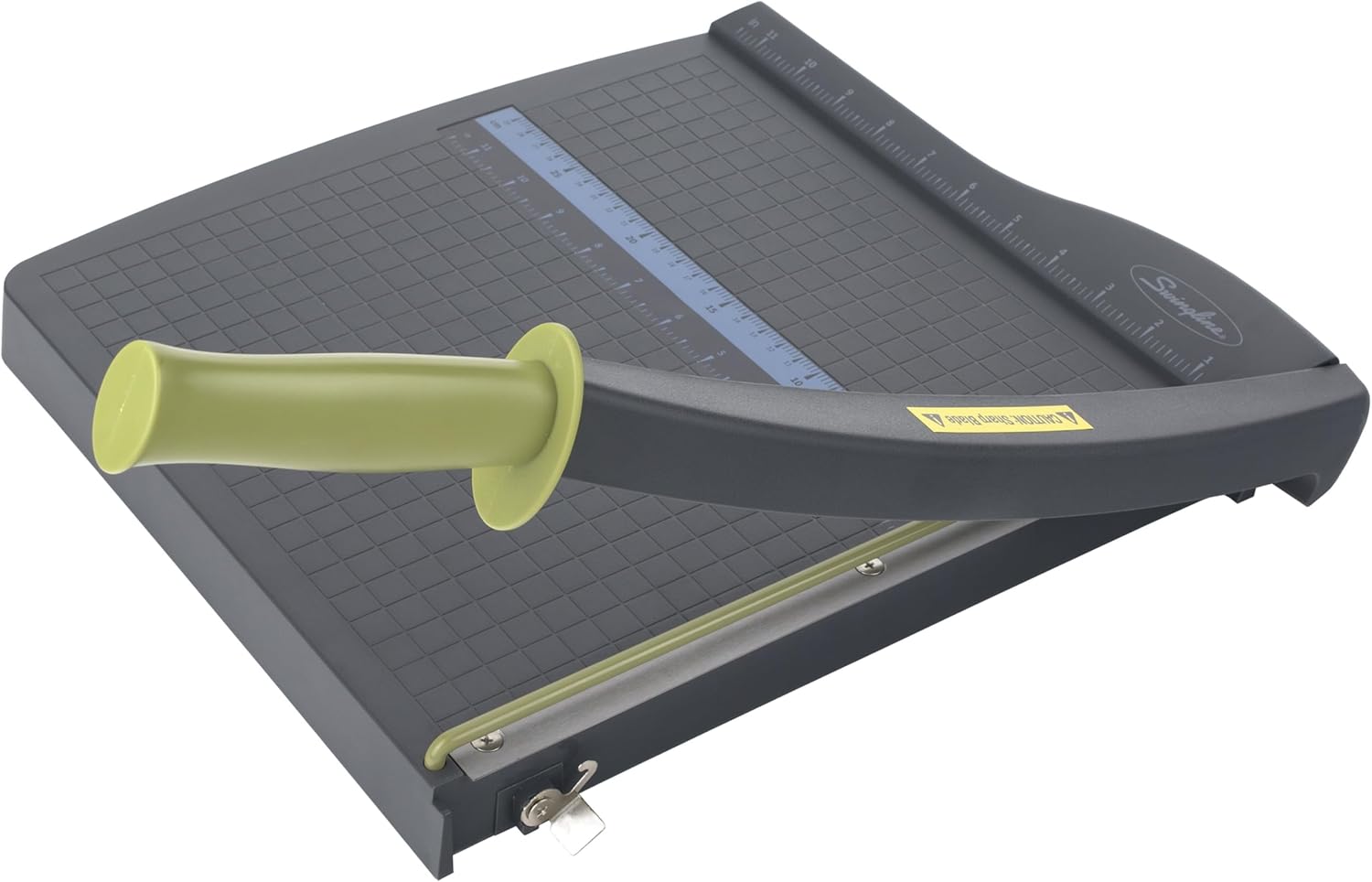
You should consider the ClassicCut Lite if a downward cutting arm suits your document routine and you have a stable place to operate it. Swingline documents a 12-inch blade, ten-sheet capacity, fixed guard rail, dual-scale alignment grid, and blade latch.
The manufacturer also recommends a maximum paper size of US Letter because of the guard rail. That detail matters more than assuming a 12-inch blade automatically means every 12-inch craft sheet will fit comfortably.
The inspected Amazon selection is the ClassicCut Lite, ten-sheet option, identified in its title as 9312. You should distinguish it from larger-capacity Swingline options on the same shopping page before comparing dimensions or making a purchase.
The lever mechanism creates a different handling routine from the two guided-head choices. Read the instructions, keep the fixed guard in place, and use the latch as directed when the cutter is stored.
You should skip it if you cannot provide stable working space or secure storage away from unintended use. Choosing another mechanism can suit your routine better, but no cutter should be treated as harmless simply because its blade is less visible.
For occasional jobs, the extra time spent setting up the workspace may matter more than the advertised stack capacity. Think through where the arm can move and where finished pieces will go before you decide the base fits your desk.
Plan the first cut before you commit a good print
Use a scrap print from the same paper pack and make one measured cut before trimming the finished copies. Check the result with your intended envelope, binder, or photo mount rather than trusting a ruler reading alone.

If the piece is wrong, check print scaling before blaming the cutter. A template printed with a fit-to-page setting can start at the wrong size, and a perfectly straight trim can’t restore the missing dimensions.
Mark the waste side lightly on the scrap so you don’t accidentally line up the finished edge on the wrong side of a crop mark. Repeat the setup slowly until you know which reference gives the result you want.
Check the second cut as carefully as the first when you’re making a rectangle. Rotate the sample and compare opposite edges, because an early alignment error can carry through the rest of a piece even when each later measurement seems sensible.
Save the successful scrap beside your project as a reference, but don’t use a soft or damaged offcut as a substitute for the tool’s measuring guides. A reference sample helps you spot a mistake; the model’s instructions still govern how you position material.
Clear away thin waste strips between jobs so you can see the base and guide markings. If a cut becomes ragged or a head feels resistant, stop and check the manufacturer’s troubleshooting advice instead of adding force or continuing through valuable prints.
Finally, decide where the cutter will go after the project and follow its storage instructions every time. A tool you can set up, use, and put away consistently is a better fit for an occasional workflow than one that only seems convenient while you’re shopping.
Make the final choice around your next three projects
Write down the page sizes, paper types, and approximate quantities for the next three jobs you actually expect to do. Compare those needs with the exact model’s cutting length, material guidance, footprint, and replacement-part availability.
Choose the Fiskars for a visible craft-alignment approach, the Dahle for its enclosed rotary-head and clamp design, or the Swingline for a Letter-oriented lever workflow. These are conditional fits based on documented construction, not an untested ranking of cut quality.
If none matches your format or volume, take the job to a local print shop before buying a more demanding machine. You can keep an occasional project simple without turning your desk into a small finishing department.
Sources & editorial notes
Sources checked October 22, 2026. Practical exercises and conditional recommendations are editorial guidance; no hands-on product testing is claimed.
- cuix-prod.fiskars.com — SureCut wire, TripleTrack mechanism, extended measuring arm, 12-inch cut, style I blades; exact Amazon selected model 152490 versus catalog suffix 1008 distinguished.
- www.dahle.com — US item 00507-24040: 12-inch cut, 7 sheets, enclosed self-sharpening bidirectional blade, auto clamp, metal base.
- www.swingline.com — SKU 9312: 12-inch blade, 10 sheets, fixed rail, latch, grid, recommended max Letter due to rail.